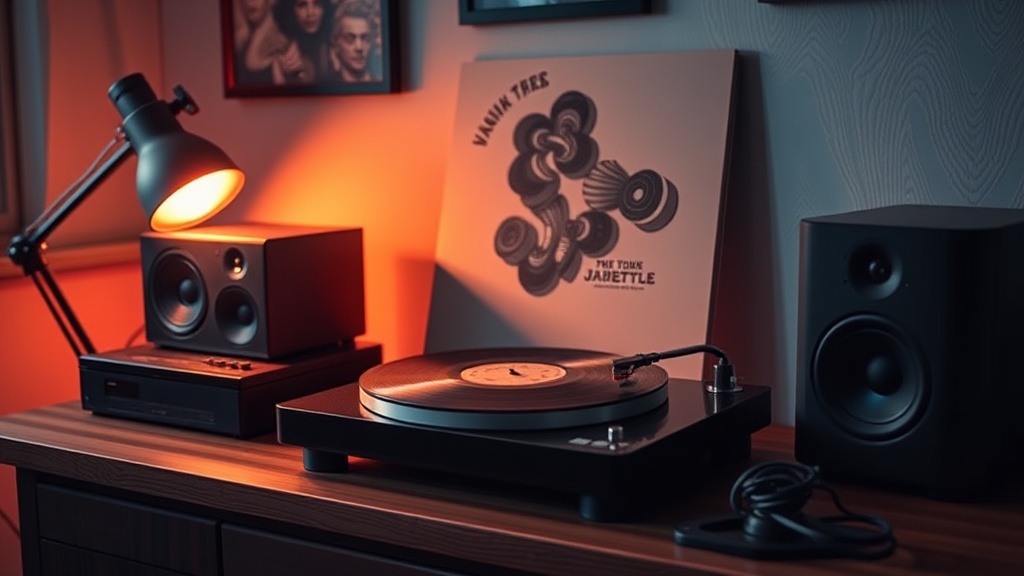
Setting Up a High-Fidelity Vinyl Listening Station

Building a High-Fidelity Setup from Scratch
Did you know that a standard needle can exert anywhere from 150 to 300 grams of pressure on a record groove during playback? While that might sound like a heavy weight, it's actually a controlled physical interaction that requires precision to prevent permanent damage. Setting up a dedicated space for your analog collection isn't just about finding a shelf; it's about managing vibration, electrical interference, and physical stability to ensure your music sounds exactly as the engineer intended.
A proper listening station begins with a solid foundation. If your turntable sits on a wobbly desk or a thin bookshelf, you're asking for trouble. Every footstep in your house—or even a heavy truck driving past your home in Kelowna—can travel through the floor and into your stylus. This creates micro-vibrations that the needle interprets as noise. You'll want to look for a dedicated equipment stand or a heavy, solid-body piece of furniture that doesn't resonate easily.
The most expensive part of your setup isn't always the turntable itself. Often, it's the signal path. An analog signal is incredibly weak and fragile. Once the needle leaves the groove, that tiny electrical pulse travels through your cartridge, up the tonearm, and through your phono preamp. If your cables are cheap or poorly shielded, you'll hear a constant-hum or background hiss that ruins the experience of a quiet jazz record.
What Equipment Do I Need for a Beginner Vinyl Setup?
Most people think they can just plug a turntable into a pair of computer speakers and call it a day. That's a mistake. You need three core components: the playback device, the amplification, and the output. Let's break down the essentials.
- The Turntable: This is your centerpiece. You'll want something with an adjustable counterweight and an adjustable anti-skate mechanism. These features allow you to tune the physical pressure of the needle.
- The Phono Preamp: Records are mastered to be quiet. A phono preamp takes the low-voltage signal from your turntable and boosts it to a level that a standard amplifier can actually use. You can get a standalone box or one built into your receiver.
- The Amplifier and Speakers: This is where the sound actually becomes audible. While many people jump to high-end speakers, a decent pair of bookshelf speakers paired with a quality integrated amplifier will do more for your sound than a single expensive pair of monitors.
If you're looking for technical specifications on how these components interact, the Stereophile website offers deep dives into component testing and frequency responses. Understanding these nuances early on will save you from buying gear that doesn't work well together.
How Do I Prevent Record Warping and Damage?
Even with the best gear, your records are susceptible to their environment. Heat is the enemy of vinyl. If you leave your collection near a radiator or in a room with direct sunlight, the PVC (polyvinyl chloride) can reach its glass transition temperature. Once it warps, the record is often permanently damaged, and your stylus will bounce rhythmically, causing even more wear.
Beyond temperature, vibration management is a constant battle. Many collectors use isolation feet for their turntables. These are small, rubberized or specialized pads that sit under the feet of the turntable. They act as shock absorbers to decouple the machine from the surface it sits on. This is a relatively inexpensive way to improve your sound quality significantly. It's not just about the music; it's about the silence between the notes.
Store your records vertically. I cannot stress this enough. Laying records on top of each other in a stack creates uneven pressure that leads to "ring wear" on the sleeve and warping of the disc. A vertical storage system—whether it's a dedicated crate or a bookshelf—ensures the weight is distributed evenly along the edges of the sleeves, rather than pressing down on the center of the record.
Does the Placement of My Turntable Matter?
Yes, it matters immensely. The physical environment of your listening station dictates the quality of your playback. You should avoid placing your turntable on top of your speakers. When the bass hits, the vibration from the speaker cabinets will travel directly into the turntable, causing the needle to jump or create a "muddy" sound. This is a common error for those building their first station.
Another factor is electromagnetic interference. If your turntable is sitting right next to a large power transformer, a Wi-Fi router, or even a large Bluetooth speaker, you might experience a low-frequency hum. This isn't a fault of your record or your stylus, but a result of the electrical environment. Keep your signal cables (the ones running from the turntable to the preamp) away from power cables whenever possible. If they must cross, try to have them cross at a 90-degree angle to minimize the chance of interference.
For those interested in the physics of sound and how it travels through different materials, Audioengine provides great resources on how speaker placement and room acoustics affect your listening experience. A well-placed speaker can change the way you perceive the soundstage of a record entirely.
As you build your station, don't feel pressured to buy everything at once. The hobby is best enjoyed by slowly upgrading one piece at a time. Start with a solid turntable and a basic phono stage, then work your way toward better amplification and eventually, higher-end speakers. The goal is to create a space where the music is the focus, and the equipment serves as a transparent window into the recording.
The setup process is a continuous loop of tweaking and testing. You might find that moving your desk two inches to the left completely eliminates a weird vibration. Or perhaps a new set of isolation pads makes your favorite Orpheus-era pressings sound clearer. That's the beauty of analog—it's a physical, tactile relationship between your gear and the music.
| Component | Primary Function | Maintenance Task |
|---|---|---|
| Turntable | Rotates the record | Clean the platter and check belt tension |
| Stylus (Needle) | Reads the grooves | Brush away dust after every few plays |
| Phono Preamp | Boosts signal voltage | Ensure cables are seated tightly |
| Speakers | Converts signal to sound | Keep away from moisture and direct heat |